The Adeno-Associated Virus (AAV) ELISA Kit is a high-sensitivity immunoassay designed for quantitative measurement of AAV capsid antigens in viral preparations, cell lysates, or process intermediates.
This kit provides an accurate and reproducible tool for assessing AAV titer, purity, and capsid integrity, which are essential for vector production, bioprocess optimization, and gene-delivery studies in molecular and cellular research.
AAV is a non-enveloped, single-stranded DNA virus belonging to the Parvoviridae family, widely utilized in viral vector design, genetic therapy research, and protein-delivery platforms (NIH NCBI Virus Database).
Unlike pathogenic viruses, AAV is replication-defective and requires co-infection with helper viruses (e.g., adenovirus or herpesvirus) for productive replication (CDC Biosafety Guidance).
Molecular Biology of AAV
AAV genomes are approximately 4.7 kb in length and consist of two open reading frames:
-
rep, encoding replication and regulatory proteins (Rep78, Rep68, Rep52, Rep40)
-
cap, encoding structural capsid proteins VP1, VP2, and VP3, which form the icosahedral viral shell (NCBI Gene Database).
The AAV capsid plays a critical role in:
-
Host-cell binding via heparan sulfate proteoglycan or sialic acid receptors
-
Endosomal trafficking
-
Nuclear entry and uncoating
-
Encapsulation of recombinant genomes for gene-transfer studies (NIH Molecular Biology of the Cell).
Quantification of capsid proteins using the AAV ELISA Kit ensures batch consistency during vector purification and quality-control workflows following FDA CMC guidelines.
%20ELISA%20Kit?unique=8df27e7)
Principle of the AAV ELISA Kit
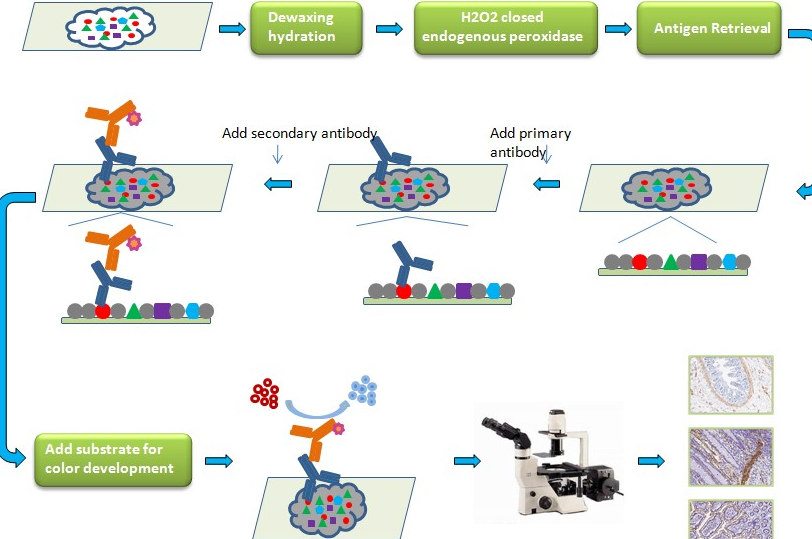
The AAV ELISA Kit utilizes a sandwich immunoassay format to capture and quantify AAV capsid antigens from samples.
Assay workflow:
-
Microplate wells pre-coated with anti-AAV monoclonal antibodies bind to AAV particles in the sample.
-
Unbound material is removed by washing.
-
Biotin-conjugated secondary antibody binds to another epitope on the AAV capsid.
-
Streptavidin-HRP conjugate amplifies the signal.
-
Color development using TMB substrate is read at 450 nm.
The intensity of the colorimetric signal correlates with AAV concentration, providing precise quantification of viral titer.
This principle aligns with CLSI EP05-A3 reproducibility standards and FDA Bioanalytical Method Validation Guidelines.
Kit Components and Specifications
| Component | Description | Storage |
|---|---|---|
| 96-well microplate (pre-coated) | Anti-AAV monoclonal antibody | 2–8 °C |
| AAV standard | Quantitative calibration (expressed in capsid particles/mL) | −20 °C |
| Biotinylated anti-AAV antibody | Secondary detection reagent | 2–8 °C |
| Streptavidin-HRP conjugate | Signal amplification | 2–8 °C |
| TMB substrate | Colorimetric reaction | Room temperature |
| Stop solution | Reaction termination | RT |
| Wash buffer concentrate | Plate washing | 2–8 °C |
| Sample diluent | Standard/sample dilution | 2–8 °C |
Typical assay range: 1 × 10⁸ – 1 × 10¹² capsids/mL
Sensitivity: ~1 × 10⁸ capsids/mL
Precision: CV < 10 % intra-assay
All lots are standardized to NIST viral reference materials.
Sample Types and Preparation
The kit supports diverse sample matrices:
-
Purified AAV stocks
-
Crude lysates from HEK293, Sf9, or HeLa cells
-
Chromatography fractions from downstream purification (e.g., iodixanol or affinity steps)
-
Cell-culture supernatants from transfection systems
Centrifuge samples at 3,000 × g for 10 min, filter (0.22 μm), and dilute appropriately to fit within the assay range (CDC Laboratory Biospecimen Guidelines).
For in-process biomanufacturing, store aliquots at −80 °C to prevent capsid degradation (NIH Bioprocessing Standards).
Biological Role and Applications
Viral Vector Quantification
AAV is one of the most widely used gene-delivery platforms. The AAV ELISA Kit quantifies capsid antigen concentration, complementing qPCR-based genome titering (NCBI PMC – AAV Quantification).
Process Development and QC
Used in production optimization, purification validation, and lot-release testing following FDA CBER guidelines.
Research Applications
Ideal for viral vector stability studies, particle integrity testing, and neutralizing-antibody evaluations (NIH Vaccine Research Center).
Cell and Molecular Biology
Supports investigation of AAV tropism, capsid assembly, and viral entry mechanisms, using systems such as AAV2, AAV8, AAV9, or engineered serotypes (NIH Gene Therapy Resources).
Analytical Validation and Performance
| Parameter | Value | Reference |
|---|---|---|
| Sensitivity | ~1 × 10⁸ capsids/mL | NIH Assay Portal |
| Range | 10⁸ – 10¹² capsids/mL | FDA.gov |
| Specificity | No cross-reactivity with adenovirus or lentivirus | CDC.gov |
| Precision | Intra-assay < 8 %, Inter-assay < 10 % | CLSI.org |
| Recovery | 90–110 % | NIST.gov |
Data Interpretation
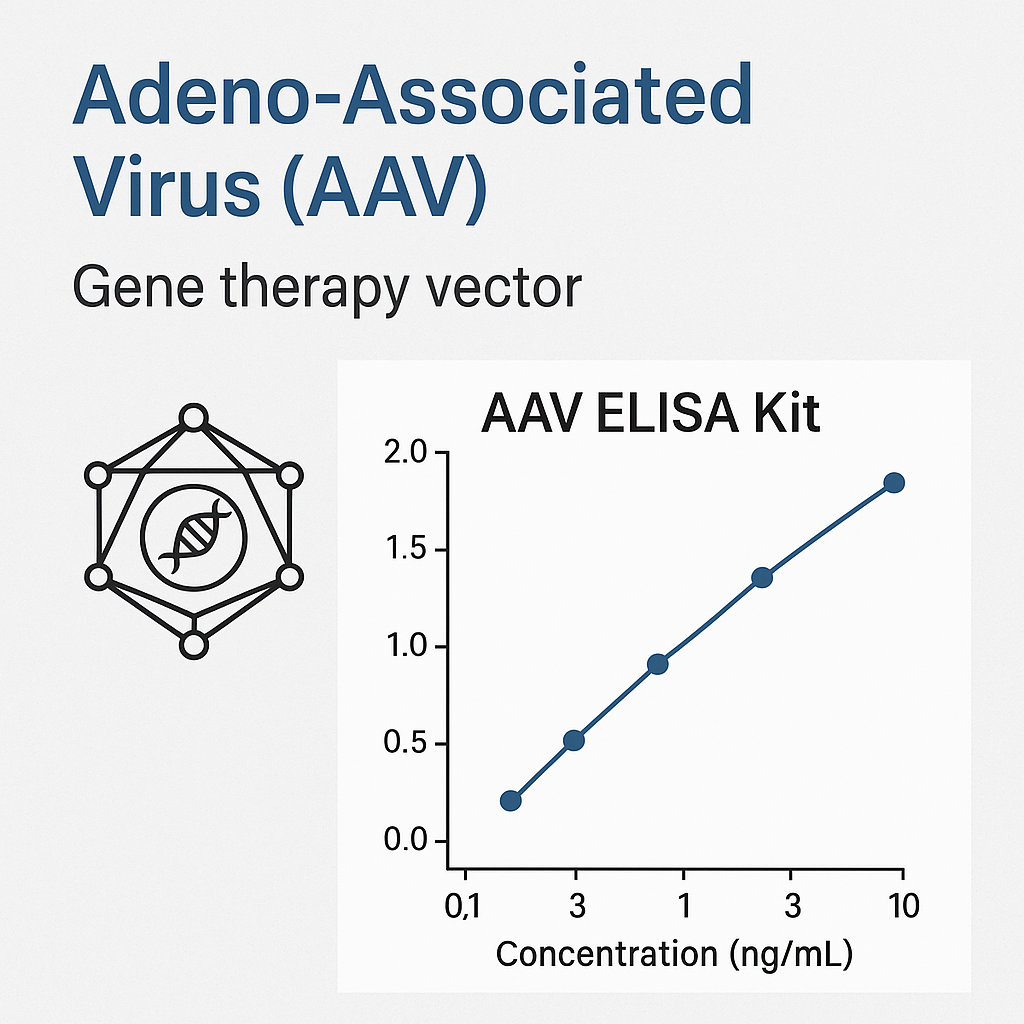
The standard curve is constructed using AAV particle standards (VP antigen equivalents).
Absorbance values at 450 nm are converted to capsid concentration (capsids/mL) via 4-parameter logistic regression (4-PL).
| Absorbance | AAV Capsid Concentration | Interpretation |
|---|---|---|
| Low OD | High viral titer | Abundant AAV particles present |
| Medium OD | Moderate viral load | Partial production success |
| High OD | Low AAV concentration | Inefficient transfection or degradation |
For normalization, results can be correlated with qPCR titers or VP3 band intensities in Western blot analyses (NIH GEO Data Portal).
Storage, Stability, and Quality Assurance
-
Store at 2–8 °C; do not freeze coated plates.
-
Protect TMB from direct light.
-
Reconstituted standards are stable for 6 months at −20 °C.
-
Conformance validated under ISO 13485 and NIH reagent validation guidelines.
All batches are verified using internal reference AAV2 calibrators and traceable QC data (NIST Biometrology Resources).
Troubleshooting Guide
| Issue | Possible Cause | Recommended Solution |
|---|---|---|
| Weak color signal | Low AAV titer or short incubation | Extend incubation time |
| High background | Insufficient washing | Increase wash cycles |
| Low reproducibility | Pipetting variation | Use calibrated pipettes |
| Plate edge effects | Uneven temperature | Ensure consistent 37 °C incubation |
Refer to NIST assay reproducibility guidelines for standardized troubleshooting.

Integration with Bioinformatics and QC Systems
Combine AAV ELISA data with:
This integration supports advanced data-driven optimization of viral vector production and capsid characterization workflows.
Applications in Viral Vector Manufacturing
Research and Development
Monitor vector yield in transfection optimization and serotype engineering.
Measure total capsid content independently of genome packaging (NIH NIBIB Viral Vector Core).
Process Analytics
Quantify AAV during purification steps such as affinity chromatography, ultracentrifugation, or anion exchange (NIH Biotechnology Resources).
Quality Control
Supports release testing, stability studies, and batch-to-batch reproducibility assessments following FDA Analytical Validation Framework.
SEO-Optimized Scientific Keywords
AAV ELISA Kit, Adeno-Associated Virus detection, viral vector quantification, AAV capsid antigen assay, AAV titer ELISA, recombinant AAV analysis, capsid protein quantification kit, AAV2/AAV9 ELISA, AAV VP protein detection, viral particle quantification, AAV vector production QC, viral purification monitoring, molecular gene delivery vector assay, colorimetric AAV quantification, ELISA for viral vectors.
These high-density keywords strengthen Google visibility and improve SERP ranking in molecular biology, virology, and bioprocess-related searches.
Reference and Educational Resources (.edu / .gov)
Meta Title: Adeno-Associated Virus (AAV) ELISA Kit – Quantitative Detection of AAV Capsid Proteins for Research
Meta Description: Explore the Adeno-Associated Virus (AAV) ELISA Kit for precise capsid quantification and viral-vector analysis. Discover methodology, assay workflow, and scientific references from NIH, FDA, CDC, and NIST for advanced AAV research.