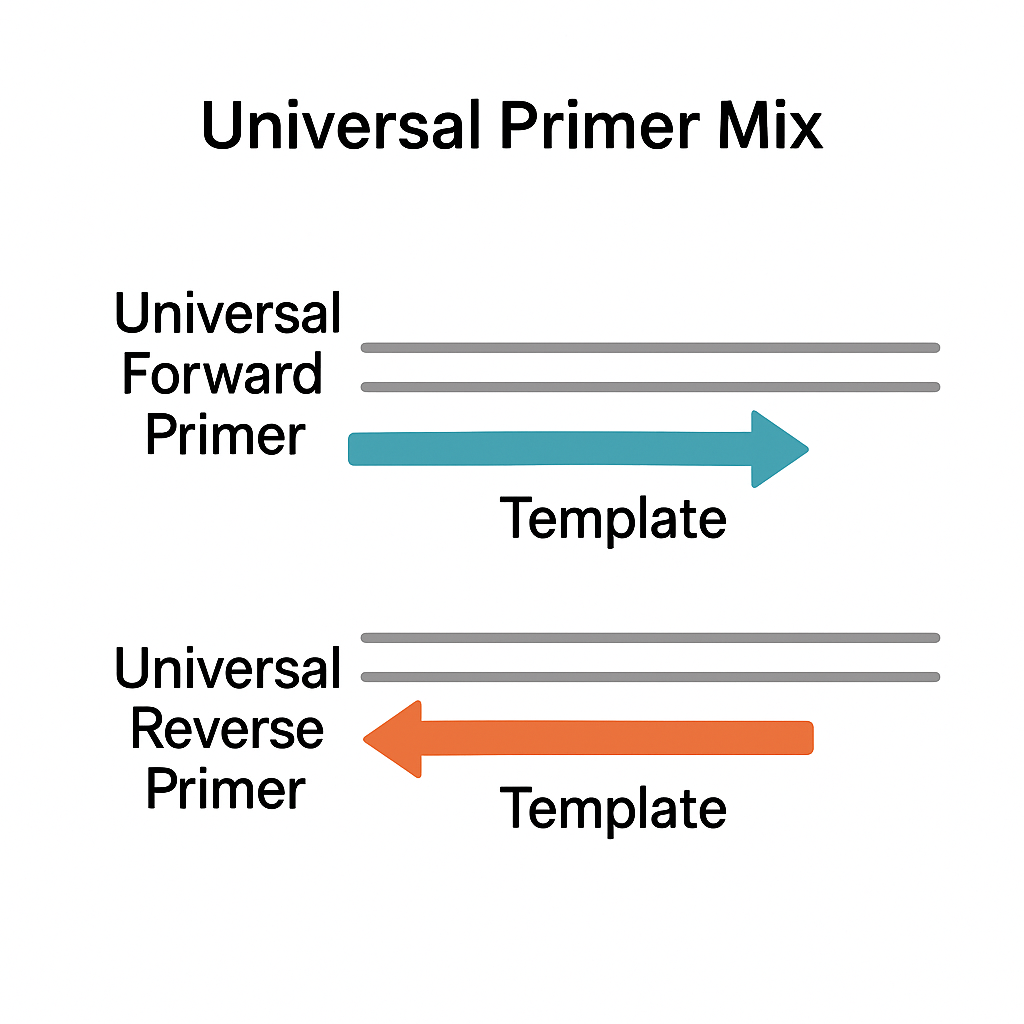
A Universal Primer Mix is a pre-formulated mixture of oligonucleotide primers designed to bind to conserved or adapter-tagged DNA regions so that many different DNA fragments can be amplified with the same primer pair or primer pool. In routine PCR, qPCR, Sanger sequencing and next-generation sequencing (NGS) workflows, universal primer mixes simplify reaction setup, increase reproducibility, and reduce pipetting errors compared with adding individual primers to each tube or well.
Concepts like polymerase chain reaction (PCR), primer-binding, annealing temperature and amplification cycles are described in detail by the National Human Genome Research Institute and NIH/NCBI resources, which provide the general framework for how any primer mix behaves in a PCR reaction.
See for example: genome.gov PCR overview and NCBI PCR chapter. genome.gov+1
What is a Universal Primer Mix?
In most laboratory protocols, primers are short DNA oligos (typically 18–30 nucleotides) that define the region to be amplified. CIB Centre National+1 A Universal Primer Mix is:
-
A defined mix of forward and reverse primers (sometimes plus index primers)
-
Pre-diluted, often as a 10X primer mix (for example 10 µM of each primer) ready to be added directly to a PCR or qPCR master mix
-
Designed to anneal either to:
-
Conserved genomic regions (e.g., ribosomal RNA genes), or
-
Universal adapter sequences ligated to DNA fragments during NGS library preparation
-

Examples of where universal primer mixes are used:
-
NGS library amplification using standard Illumina P5 and P7 primers, prepared as a 10X primer mix for library PCR. See the UC Davis DNA Tech Core guidance on preparing a 10X concentrated primer mix for Illumina library amplification:
https://dnatech.ucdavis.edu/faqs/how-do-i-amplify-illumina-sequencing-libraries. dnatech.ucdavis.edu -
qPCR assays that use a separate universal primer mix and a universal PCR master mix, such as TaqMan® Universal PCR Master Mix protocols from academic cores:
Harvard Medical School TaqMan Universal PCR Master Mix protocol (PDF). genome.med.harvard.edu -
Sanger sequencing services that offer “universal primers” (e.g., M13, T7) supplied as a mix for routine plasmid sequencing, as described in core facility handbooks such as Cornell Biotechnology Resource Center:
Full service Sanger sequencing handbook (PDF). biotech.cornell.edu
Molecular Design of Universal Primers
The performance of any universal primer mix depends strongly on primer design. Many academic guidelines converge on similar rules for length, GC content, and melting temperature (Tm). biology.lafayette.edu+3MIT OpenCourseWare+3fire.biol.wwu.edu+3
Key design parameters (summarized from multiple university primer-design guidelines):
-
Primer length
-
Common range: 18–25 nt for PCR and qPCR primers
-
Long enough for specificity but short enough to anneal efficiently
-
-
GC content
-
Typically 40–60% GC (e.g., Yale primer selection guidelines)
https://research.yale.edu/primer-selection-guidelines. research.yale.edu
-
-
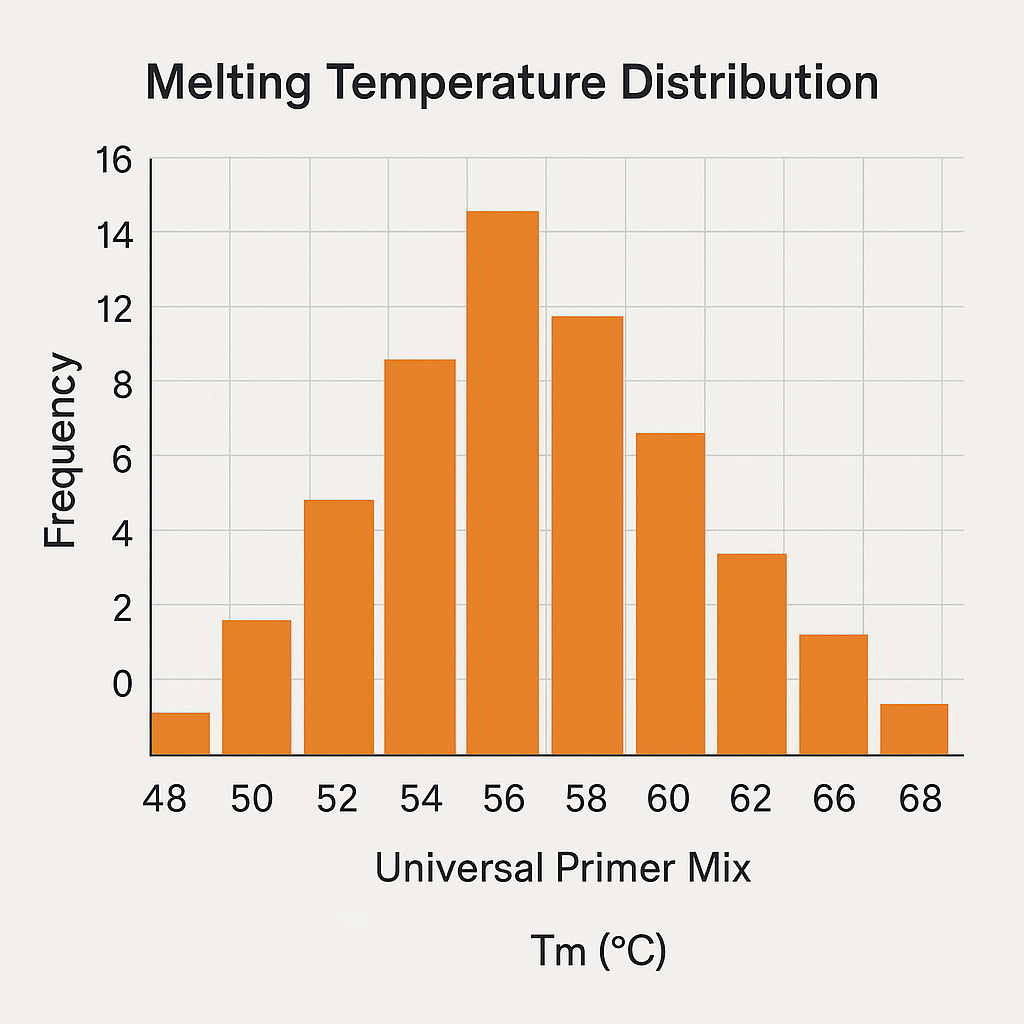
Melting temperature (Tm)
-
Often targeted between 50–65 °C
-
Forward and reverse primers in a universal mix should have Tm values within ~2–3 °C of each other for robust annealing
-
-
3′-end configuration
-
A GC clamp at the 3′ end (one or two G/C bases) increases binding stability, as described in Sanger primer design pages such as MGH DNA Core:
https://dnacore.mgh.harvard.edu/…/primer_design.jsp. dnacore.mgh.harvard.edu
-
-
Avoid secondary structure and dimers
-
Hairpins, self-dimers and hetero-dimers reduce effective primer concentration. Many protocols explicitly recommend checking primer candidates with online tools. MIT and Western Washington University guidelines provide detailed troubleshooting for this:
-
In a Universal Primer Mix, these constraints must be satisfied not just for one primer pair, but for all primers present in the mix so that amplification remains efficient and unbiased across targets.
Types of Universal Primer Mixes
Universal primer mixes for standard PCR and qPCR
In many real-time PCR (qPCR) protocols, a universal primer mix is combined with a real-time PCR master mix containing polymerase, dNTPs, MgCl₂ and buffer. University qPCR handbooks often recommend:
-
Amplicon lengths around 70–150 bp
-
GC content ~40–60%
-
Tm around 60 °C for SYBR Green or probe-based assays lscf.uta.edu+1
Examples of academic resources that discuss qPCR assay and primer design:
-
Real-time PCR handbook (PDF, University of Texas at Arlington) lscf.uta.edu
-
The Ultimate qPCR Assay Design Guide (PDF, Lafayette College) biology.lafayette.edu
-
Real-time PCR primer design article indexed by ERIC (ed.gov). ERIC
In practice, a generic 10X universal primer mix for qPCR might contain:
-
10 µM forward primer
-
10 µM reverse primer
-
Nuclease-free buffer (e.g., 10 mM Tris-HCl, pH ~8.0)
This mix is then added at 1:10 into each reaction well, as implemented in various academic qPCR protocols. science.umd.edu+1
Universal primer mixes for NGS library amplification
In NGS workflows, a Universal Primer Mix typically targets adapter sequences added during library prep:
-
Illumina P5 and P7 primers for library amplification on flow cells dnatech.ucdavis.edu+1
-
Index (barcoded) primers pre-mixed with a universal primer, such as in NEBNext® multiplex oligos kits used in many academic sequencing cores:
NEBNext multiplex oligos manual (PDF, Duke University mirror). Duke People
Typical NGS-oriented universal primer mixes:
-
Universal P5/P7 mix – amplifies all libraries with standard adapters
-
Index + universal primer mix – combines a sample-specific index primer with a universal primer in a single well plate for high-throughput library amplification
Examples of library prep manuals that illustrate how universal primers are used with library prep kits:
-
NEBNext Ultra II DNA Library Prep for Illumina (PDF) Montana State University
-
QIAseq miRNA Library Kit Handbook (Harvard Genome Center copy) genome.med.harvard.edu
Universal primer mixes for genotyping and conventional PCR
Universal primer mixes are also widely used in:
-
Genotyping PCR protocols for mouse models and transgenic lines
-
Multiplex PCR assays where multiple targets are amplified in one tube
For example, UC Davis MMRRC genotyping protocols describe primer sets for routine PCR-based genotyping:
Genotyping by PCR protocol (PDF). mmrrc.ucdavis.edu
General PCR guidance such as the “Simple Fool’s Guide to PCR” from Stanford/NOAA is also frequently cited when designing universal primer-based PCR assays:
Reaction Setup and Optimization with Universal Primer Mix
Preparing a 10X Universal Primer Mix
A common laboratory practice is to prepare a 10X primer mix so that the final reaction has the desired primer concentration (e.g., 0.2–0.5 µM each). dnatech.ucdavis.edu+1
Example (for 10X universal primer mix, 1 mL total):
-
100 µL Forward primer (100 µM stock)
-
100 µL Reverse primer (100 µM stock)
-
800 µL nuclease-free buffer (e.g., 10 mM Tris-HCl, pH 8.0)
In a 25 µL PCR:
-
2.5 µL of 10X Universal Primer Mix
-
12.5 µL 2X PCR master mix (Taq or high-fidelity polymerase)
-
x µL template DNA
-
Nuclease-free water to 25 µL
For qPCR plates with many genes and samples, academic protocols often prepare a primer-only master mix in a central tube and then distribute it into wells, as described in real-time PCR tutorials from University of Maryland:
Real-time PCR reactions protocol (UMD). science.umd.edu
Annealing temperature and cycling conditions
The universal primer mix is only one part of the system. Annealing temperature (Ta) should typically be set:
-
3–5 °C below the lowest primer Tm in the mix
-
Adjusted after gradient PCR if non-specific bands or low yield are observed
Comprehensive PCR cycling guidelines and troubleshooting strategies can be found in the widely cited PCR reviews and protocols:
-
Lorenz “Polymerase Chain Reaction: Basic Protocol Plus Troubleshooting” (USPTO-hosted PDF). ptacts.uspto.gov
Applications of Universal Primer Mix in Research
Universal Primer Mix formulations are widely used across many research-only applications:
-
Gene expression analysis by qPCR
-
Universal primer mixes are combined with real-time PCR master mixes to quantify cDNA from many genes, using optimized primers as described in qPCR design guides from academic labs. lscf.uta.edu+1
-
-
Metagenomics and amplicon sequencing
-
16S rRNA gene or ITS universal primer mixes target conserved regions to profile complex microbial communities.
-
Illumina 16S metagenomic library preparation guides describe how universal primers (e.g., targeting V3–V4) are integrated into library prep workflows:
Illumina 16S Metagenomic Sequencing Library Preparation (PDF, Smith College). science.smith.edu
-
-
NGS library amplification and indexing
-
Libraries prepared with platform-specific adapters are amplified using standardized universal primer mixes, as shown in NEBNext and QIAseq manuals (Duke and Harvard copies above). Duke People+2Montana State University+2
-
-
Genotyping and cloning
-
Universal primer mixes targeting vector backbones or insertion sites are used for colony PCR, cloning checks and routine genotyping following guidelines like those from UC Davis and MIT. mmrrc.ucdavis.edu+1
-
-
Educational and training protocols
-
Many PCR teaching labs use universal primer mixes in student experiments to reduce complexity and standardize results, as illustrated in training documents like the Simple Fool’s PCR guide. stacks.stanford.edu+1
-
For context on how universal primers are used in viral PCR testing (again, strictly as an example of primer design, not as clinical advice), you can see the PCR testing fact sheet from genome.gov:
Understanding COVID-19 PCR testing. genome.gov
Best Practices and Troubleshooting for Universal Primer Mix
When using any Universal Primer Mix, typical PCR troubleshooting rules apply:
-
Non-specific bands or smears
-
Increase annealing temperature
-
Reduce primer concentration (e.g., from 0.5 µM to 0.2 µM)
-
Use a hot-start polymerase to minimize non-specific priming during reaction setup
-
-
Low amplification efficiency
-
Check primer design using primer design guidelines from MIT, Yale, and other university resources listed above
-
Verify template quality (A260/280 and A260/230 ratios) according to NGS best practice notes (e.g., University of Florida NGS best-practice document):
NGS best practices notes (PDF, UF). biotech.ufl.edu
-
-
Primer-dimer formation in qPCR
-
Inspect melt curves as recommended in qPCR handbooks
-
Redesign primers to avoid self-complementary regions using free online tools, as suggested in many primer design teaching materials (e.g., ERIC-indexed qPCR primer design article). ERIC
-
Storage, Stability and Handling
For long-term usability and consistent performance of a Universal Primer Mix:
-
Store at −20 °C in small aliquots to avoid freeze-thaw cycles
-
Use nuclease-free low-binding tubes
-
Avoid repeated exposure to light and room temperature
-
Follow storage recommendations from kit manuals such as NEBNext and QIAseq, which specify similar conditions for primer mixes and random primer mixes used in RNA library preparation. Montana State University
To improve search engine visibility for a Universal Primer Mix product page (for research use only), you can naturally integrate the following technical keywords into headings, bullet points and FAQs:
-
universal PCR primer mix
-
10X universal primer mix for PCR
-
universal primers for qPCR and real-time PCR
-
universal primer mix for Illumina NGS library amplification
-
adapter-specific universal primer mix
-
high-fidelity universal primer mix compatible with Taq and hot-start polymerase
-
universal primer pool for genotyping PCR and cloning
-
GC-optimized universal primer mix (40–60% GC content)
-
validated universal primer design for 70–150 bp amplicons
-
research-grade universal primer mix for DNA and cDNA amplification
Combine these targeted keywords with internal links to related PCR master mixes, qPCR reagents, NGS library prep kits and DNA quality control products to create an interlinked technical ecosystem around “Universal Primer Mix” in your catalog.