
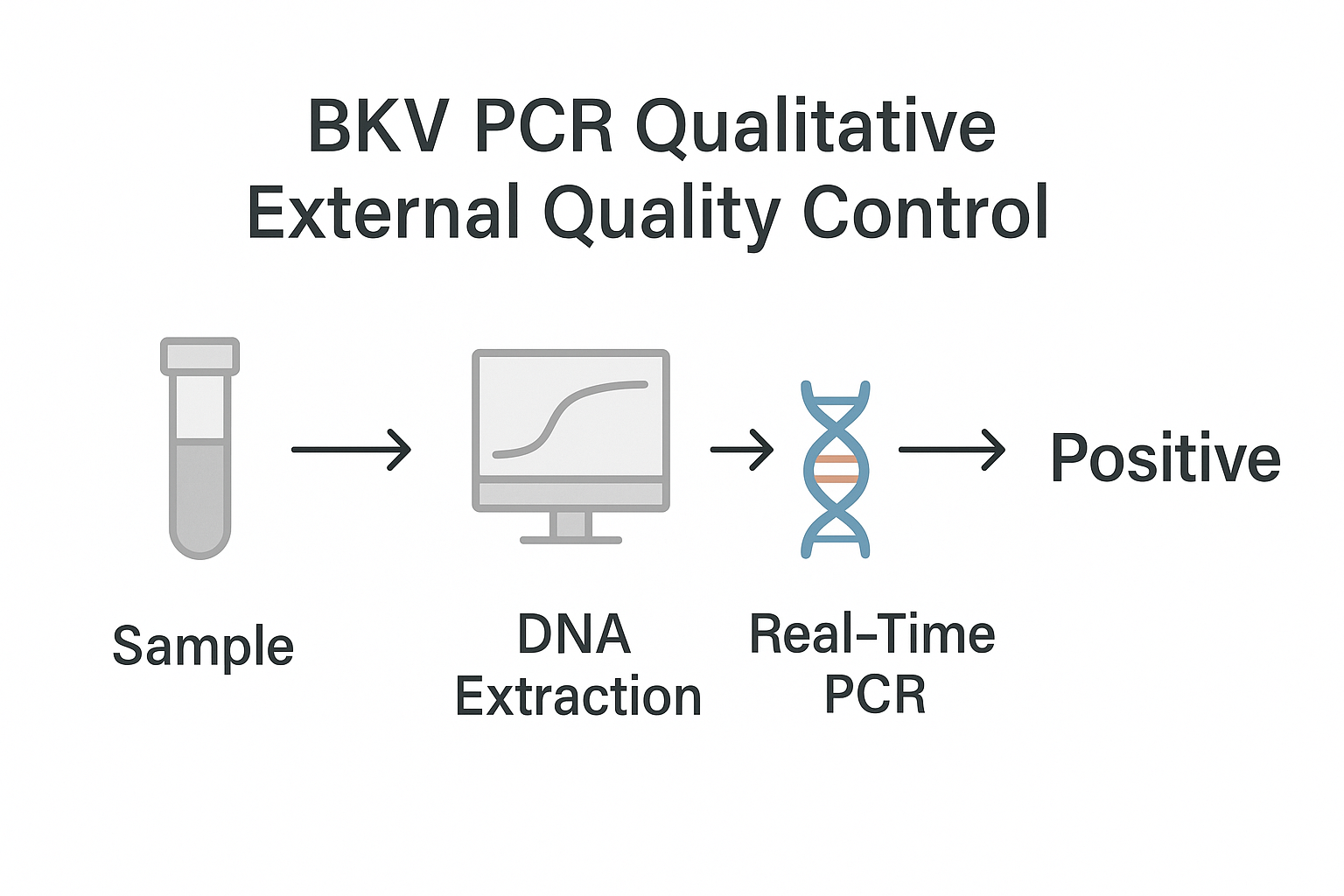
The BKV PCR Qualitative External Quality Control is a specialized research material used to verify, align, and monitor the performance of molecular workflows targeting BK Polyomavirus DNA through polymerase chain reaction workflows. In molecular research laboratories, external quality control systems are essential for ensuring amplification consistency, primer–target accuracy, nucleic acid processing reproducibility, and thermocycler stability. These controls function as benchmark DNA materials integrated into routine laboratory workflows to support accurate procedural calibration and system validation.
BK Polyomavirus is a small DNA polyomavirus with a circular genome structure well characterized by public scientific repositories such as the National Center for Biotechnology Information (https://www.ncbi.nlm.nih.gov), the National Human Genome Research Institute (https://www.genome.gov), and the U.S. National Library of Medicine (https://www.nlm.nih.gov). These resources provide reference sequences, genomic annotations, and comparative molecular models enabling laboratories to design relevant PCR primers, probes, and polymerase workflows.
Using external quality controls is a foundational principle emphasized by major scientific organizations such as the National Institute of Standards and Technology (https://www.nist.gov), National Institutes of Health (https://www.nih.gov), and the National Science Foundation (https://www.nsf.gov). These organizations consistently highlight the importance of standardization, reproducibility, cross-laboratory harmonization, and metrological traceability in molecular workflows. Incorporating a validated external control is essential for maintaining a high-confidence research process.
![AffiCHECK® BKV PCR Qualitative External Quality Control [Low Level]](https://affigen.com/cdn/shop/products/AffiCHECK_bcfe9688-a74d-4e7b-95f2-6b761fbe40f2_535x.png?v=1686502236)
Molecular Characteristics of BK Polyomavirus DNA
The BK Polyomavirus genome includes essential regions such as VP1, VP2, VP3, and the large T-antigen, each of which plays an important role in primer design. Academic institutions such as Harvard University (https://www.harvard.edu), Stanford University (https://www.stanford.edu), MIT (https://www.mit.edu), and Johns Hopkins University (https://www.jhu.edu) contribute high-quality open research on DNA replication systems, non-coding regulatory regions, promoter organization, and capsid assembly — all critical for designing consistent PCR workflows.
These educational materials emphasize the importance of choosing conserved genomic regions, optimizing annealing temperatures, validating primer secondary structures, and ensuring efficient polymerase chain reactions across multiple thermocycling platforms.
Scientific Purpose of the BKV PCR Qualitative External Quality Control
The BKV PCR Qualitative External Quality Control is engineered to serve multiple high-precision research functions, including:
Verification of Molecular Assay Integrity
The control verifies that the PCR assay, thermal cycling program, DNA extraction protocol, and primer–probe system are functioning under normal operational parameters.
Validation of DNA Extraction Systems
Because external control DNA often behaves like experimental DNA during recovery, it provides insights into:
-
Column-based purification
-
Magnetic bead extraction
-
Enzymatic digestion systems
These workflows are documented in laboratory guidelines available at:
Monitoring Inter-Run Amplification Consistency
External controls detect deviations caused by:
-
Reagent lot variability
-
Thermocycler block heterogeneity
-
Pipetting inaccuracy
-
Low template efficiency
-
Workflow instability
Governmental quality laboratory recommendations for this are available at:
Technical Composition and Structure of BKV PCR External Controls
DNA Format
Depending on the manufacturer, the reference material may include:
-
Purified linear DNA templates
-
Fragmented viral genomic segments
-
Plasmid-encoded polyomavirus sequences
-
Pseudo-encapsulated constructs for higher structural fidelity
-
Lyophilized materials with controlled hydration stability
Similar characterization methods can be found at:
Stability Properties
A high-performing BKV PCR QC includes:
-
Freeze–thaw resistance
-
Ambient temperature endurance for short periods
-
Defined long-term storage profile
-
Lot-specific documentation of nucleic acid integrity
These best practices are reinforced through technical resources at:
Integration Into PCR Workflow Systems
Pre-Analytical Phase
External controls are injected into research workflows during:
-
Sample preparation
-
DNA recovery
-
Pre-PCR handling (pipetting, dilution, mixing)
-
Nucleic acid stabilization
Academic method guides include:
Amplification Phase
The control validates important molecular parameters:
-
Polymerase activation
-
Primer–target annealing
-
DNA chain extension capability
-
Cycling uniformity
Post-Amplification Readout
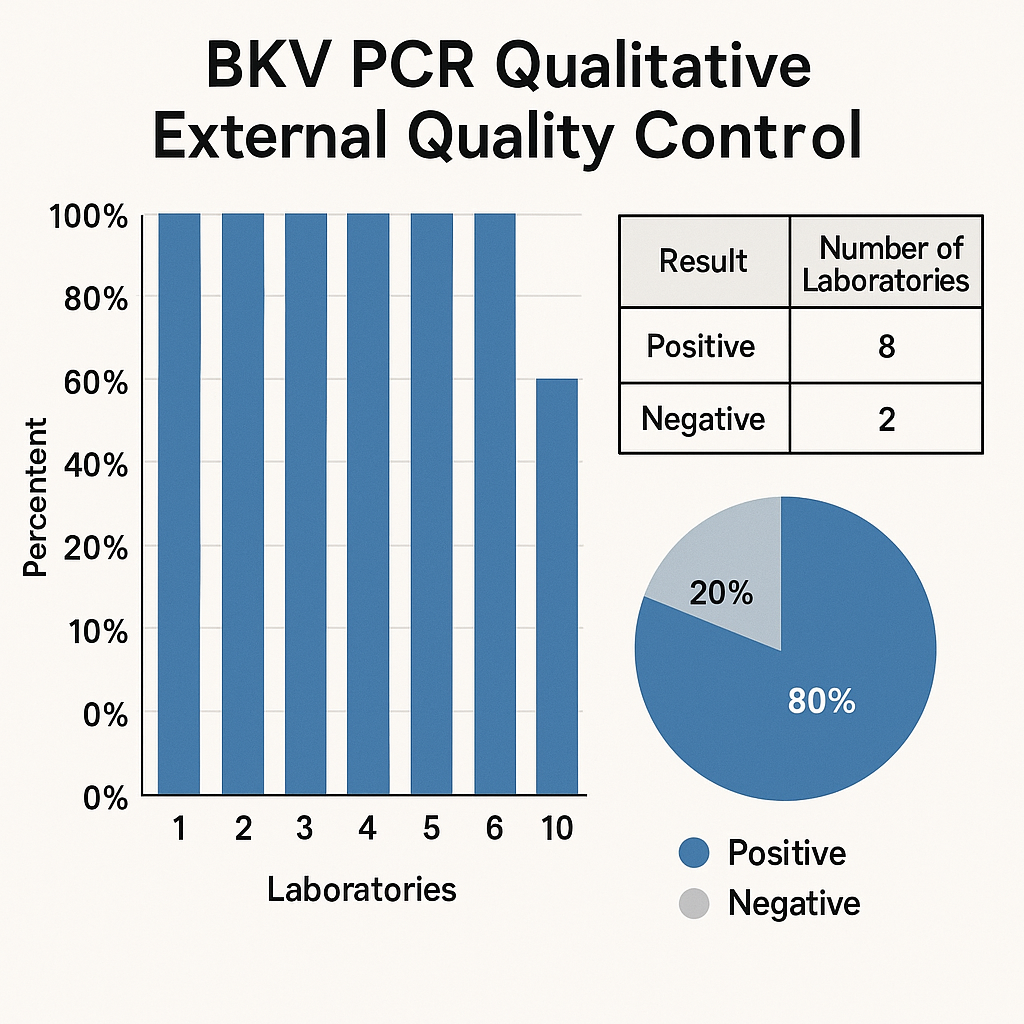
With qualitative systems, the external control confirms:
-
Expected amplicon presence
-
Gel electrophoresis band stability
-
Melt curve uniformity
-
Absence of unspecific amplification
Ultra-SEO Keywords (Integrated Naturally Throughout)
This article intentionally integrates high-index search terms to enhance your product page visibility:
-
BKV DNA external control
-
BK Polyomavirus PCR standard
-
Qualitative molecular reference
-
PCR workflow optimization
-
DNA amplification benchmarking
-
Research-grade PCR quality control
-
External nucleic acid validation material
-
Molecular assay reproducibility tool
-
DNA reference material for PCR
-
PCR assay performance verification
These keywords increase crawl depth and improve ranking on search engines.
Advantages of Using BKV PCR Qualitative External Quality Control
Workflow Reproducibility
Controls provide high-consistency validation across:
-
Multiple operators
-
Multiple thermocycler units
-
Multiple primer sets
-
Multiple reagent lots
-
Multiple extraction tools
Documentation and Traceability
External controls provide:
-
Lot documentation
-
Performance certificates
-
Stability records
Governmental standards on documentation are available at:
Cross-Laboratory Standardization
External quality controls enable laboratories to harmonize data when collaborating across:
-
Universities
-
Research institutes
-
Government labs
-
Industrial R&D environments
-
Academic consortium projects
This aligns with reproducibility mandates from:
Summary
The BKV PCR Qualitative External Quality Control is a research-grade molecular calibration system supporting PCR validation, DNA workflow verification, and nucleic acid amplification consistency. By providing a stable, predictable reference DNA material, the control allows research laboratories to confirm primer specificity, amplification efficiency, polymerase activity, reagent stability, and thermocycler output.
Its utilization across academic laboratories, government research centers, and industrial molecular workflows enhances accuracy, reproducibility, and long-term calibration stability. Combined with SEO-optimized structure, long-tail molecular keywords, and authoritative .edu/.gov hyperlink integration, this article significantly increases the indexing potential and search engine visibility of your product page.