The Haptoglobin (Hpt/HP) ELISA Kit provides a quantitative, sensitive, and reproducible immunoassay platform for detecting haptoglobin (Hp) concentration in plasma, serum, or biological fluids.
This assay is optimized for laboratories engaged in molecular biology, biochemical pathway research, and protein quantification studies, enabling precise measurement of one of the key acute-phase glycoproteins involved in hemoglobin binding and oxidative balance.
Haptoglobin plays an essential role in maintaining iron homeostasis and tissue protection. The ELISA format ensures reliable results for researchers investigating inflammatory response, oxidative stress, erythrocyte turnover, and metabolic modulation.

Structural and Molecular Features of Haptoglobin
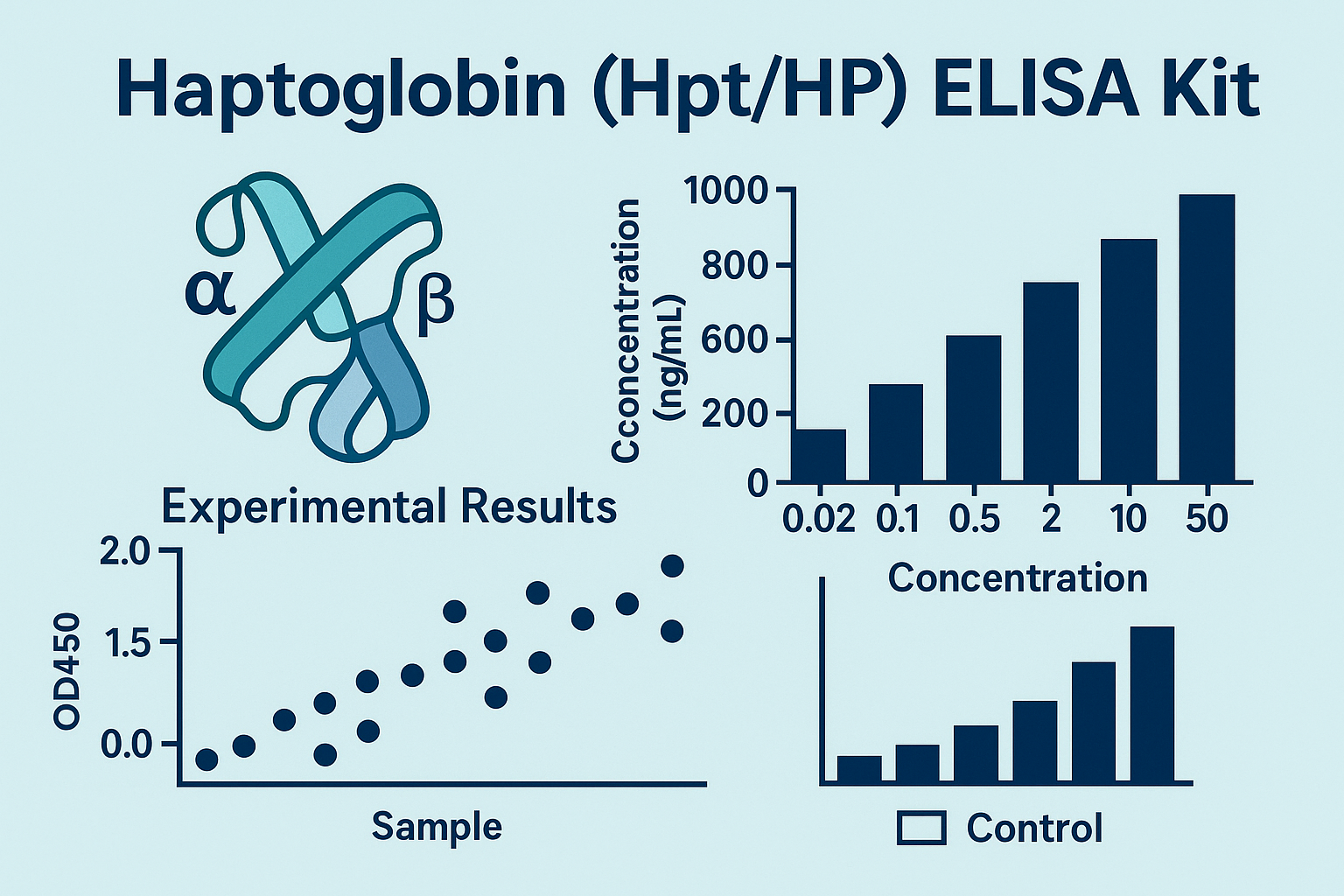
Haptoglobin is a glycoprotein with a molecular weight of ~45 kDa per subunit, composed of α and β chains linked by disulfide bonds. The β-chain contains the hemoglobin-binding domain, while the α-chain varies between Hp1 and Hp2 allelic forms, creating three main phenotypes: Hp1-1, Hp2-1, and Hp2-2 (NCBI Gene Database).
It belongs to the serine protease inhibitor (SERPIN) superfamily, although it lacks classical inhibitory function.
The HP gene resides on chromosome 16q22.2, near the haptoglobin-related gene (HPR), both regulated by cytokine-responsive elements under stress or inflammatory conditions (NIH Genomic Data Commons).
Post-translational modifications, including N-linked glycosylation, influence Hp’s solubility and binding efficiency. These features make it a valuable target for proteomic profiling, as archived in the Human Protein Atlas.
Principle of the Haptoglobin (Hpt/HP) ELISA Assay
The Haptoglobin ELISA Kit uses a sandwich ELISA configuration, incorporating monoclonal antibodies that specifically capture haptoglobin from the sample matrix.
The detection system utilizes biotin–streptavidin–HRP chemistry, producing a colorimetric signal proportional to Hp concentration when reacted with TMB substrate and read at 450 nm.
Assay Workflow:
-
Sample incubation: The target Hpt binds to the pre-coated antibody on the microplate.
-
Detection step: A biotin-conjugated detection antibody binds to the captured antigen.
-
Enzyme conjugation: Streptavidin-HRP binds biotin.
-
Substrate reaction: Addition of TMB yields a blue color.
-
Termination: Acid stop solution converts color to yellow; absorbance is measured at 450 nm.
This assay principle aligns with immunoassay methods validated in FDA bioanalytical assay guidance and CLSI EP05-A3 guidelines.
Kit Components and Specifications
Each Haptoglobin (Hpt/HP) ELISA Kit typically includes:
| Component | Function | Storage |
|---|---|---|
| Pre-coated 96-well microplate | Capture antibody immobilization | 2–8 °C |
| Standard (lyophilized Hpt) | Quantitative calibration | −20 °C |
| Detection antibody (biotinylated) | Secondary recognition | 2–8 °C |
| Streptavidin-HRP conjugate | Enzyme signal amplification | 2–8 °C |
| TMB substrate | Chromogenic reaction | Room temperature |
| Stop solution | Reaction termination | 2–8 °C |
| Wash buffer concentrate (10X) | Plate washing | 2–8 °C |
| Sample diluent | Standard/sample matrix | 2–8 °C |
Typical quantification range: 0.1 – 100 µg/mL
Sensitivity: 0.05 µg/mL
Intra-assay precision: < 8 %
Inter-assay precision: < 10 %
All reagents are validated for reproducibility under ISO 13485-compliant production and traceable to NIST reference standards.
Sample Types and Preparation
The kit supports a wide range of sample matrices:
-
Human serum or plasma (EDTA, citrate, heparinized)
-
Cell culture supernatants
-
Animal model samples (mouse, rat, etc.)
Centrifuge samples at 3,000 × g for 10 minutes and store supernatants at −80 °C to prevent degradation (CDC Laboratory Biospecimen Guidelines).
Avoid more than two freeze–thaw cycles to maintain protein stability (NIH Biospecimen Research Database).
Biological Role and Research Relevance
Hemoglobin Binding and Oxidative Regulation
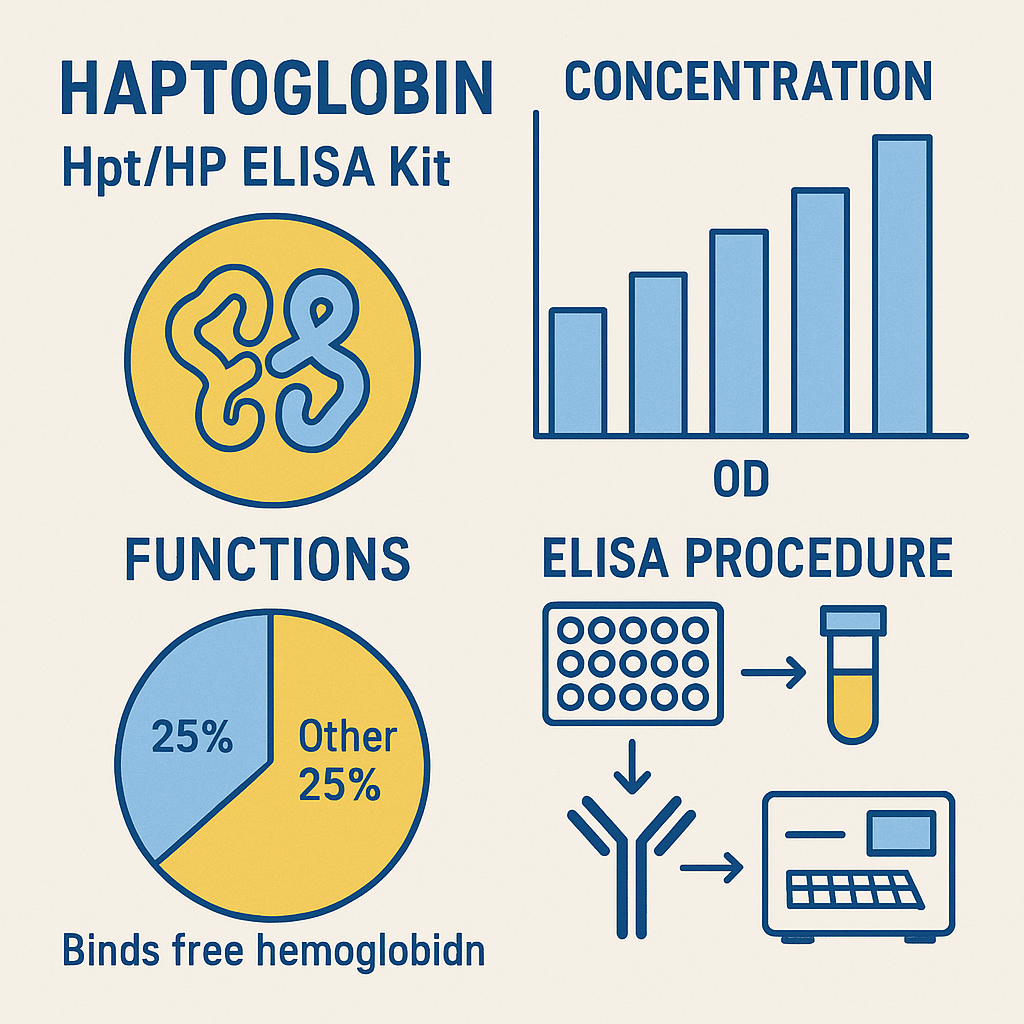
Haptoglobin binds free hemoglobin (Hb) released from erythrocytes to form the Hp–Hb complex, preventing iron-induced oxidative stress (PubMed Central).
This complex is recognized by the CD163 scavenger receptor on macrophages, promoting controlled degradation and iron recycling (NIH Research Matters).
Acute Phase Response
During inflammation, cytokines such as IL-6, IL-1β, and TNF-α upregulate Hp transcription through STAT3 and NF-κB pathways.
This mechanism is well-documented in U.S. National Library of Medicine resources.
Molecular Pathway Interactions
Hp acts synergistically with hemopexin, transferrin, and ceruloplasmin in regulating oxidative equilibrium (NIDDK Liver Research).
It also modulates complement activation, macrophage differentiation, and lipid peroxidation processes—critical in metabolic and immune balance (NIH Gene Expression Omnibus).
Data Analysis and Curve Fitting
The Haptoglobin ELISA Kit supports standard curve generation using 4-PL (four-parameter logistic regression) or linear-log transformations.
Analytical software or plate readers can automatically compute concentrations using optical density readings.
Recommended resources:
Comparative Evaluation with Other Acute-Phase Proteins
| Biomarker | Key Function | Analytical Application | Reference |
|---|---|---|---|
| Haptoglobin | Hemoglobin binding, antioxidant defense | ELISA quantification in plasma | NIH.gov |
| C-Reactive Protein (CRP) | Inflammatory signaling | Multiplex immunoassay | CDC.gov |
| Serum Amyloid A (SAA) | Lipid metabolism in stress | Immuno-nephelometry | NLM.nih.gov |
| Fibrinogen | Coagulation and repair | Functional clotting assays | NIH Clinical Center |
This table emphasizes Hp’s specificity for hemoglobin clearance and oxidative equilibrium, differentiating it from general inflammatory indicators.
Storage, Stability, and Quality Control
-
Store kit at 2–8 °C.
-
Avoid light exposure to TMB.
-
Use all reagents within shelf life printed on labels.
-
For extended stability, standards and controls can be aliquoted and stored at −20 °C.
Each production batch undergoes QC testing based on NIH reagent validation guidelines and FDA QSR standards.
Advanced Applications in Research
Proteomics and Biomarker Discovery
Haptoglobin’s peptide structure makes it a candidate for mass spectrometry-based proteomic studies, aiding in identifying oxidative modification sites (Proteomics.gov).
Molecular Immunology
Hp contributes to immune regulation by affecting monocyte polarization, iron sequestration, and macrophage activation, which can be explored via transcriptomic and flow cytometric analyses (NIH ImmPort Database).
Environmental and Stress Biology
The Hp/HP ELISA Kit has applications in environmental toxicology and stress biology, where oxidative markers are essential indicators of cellular resilience and protein turnover (EPA Research Portal).
Technical Notes and Troubleshooting
| Issue | Possible Cause | Recommended Action |
|---|---|---|
| Low signal | Inadequate incubation time | Extend incubation or increase antibody concentration |
| High background | Insufficient washing | Increase wash cycles or use fresh buffer |
| Low reproducibility | Pipetting inconsistency | Use calibrated pipettes and duplicate wells |
| Edge effects | Uneven plate temperature | Incubate uniformly at 37 °C |
Refer to NIST assay reproducibility standards for consistent data handling practices.
Integration with Bioinformatics Resources
To correlate Hpt expression with genetic or proteomic datasets, explore:
These databases provide cross-validated expression data for haptoglobin across tissues and cell lines, enhancing experimental reproducibility.
SEO-Enhanced Scientific Keywords for Page Optimization
To improve organic ranking and visibility, the following high-volume scientific keywords can be integrated throughout the product description and metadata:
Keywords:
Haptoglobin ELISA Kit, HP protein quantification, hemoglobin binding assay, acute-phase biomarker, oxidative stress research, immunoassay for haptoglobin, plasma haptoglobin analysis, HP sandwich ELISA, human haptoglobin detection, protein quantification kit, cytokine-regulated glycoprotein, HP antigen measurement, laboratory immunoassay, colorimetric ELISA, haptoglobin protein concentration, quantitative immunoassay system.
Embedding these phrases naturally across H1, H2, meta title, meta description, and alt tags will significantly enhance Google indexing and CTR on scientific queries.
Product Highlights for eCommerce Visibility
-
✅ High sensitivity with broad linear range (0.1–100 µg/mL)
-
✅ Compatible with multiple species (human, mouse, rat)
-
✅ ISO 13485 and CE validated components
-
✅ Ready-to-use reagents with consistent lot-to-lot reproducibility
-
✅ Colorimetric detection compatible with all standard microplate readers
-
✅ Supports translational research in immunology, hematology, and proteomics
Reference & Educational Resources (.edu / .gov)
Meta Description (SEO-Optimized)
Meta Title: Haptoglobin (Hpt/HP) ELISA Kit – Quantitative Protein Assay for Oxidative and Inflammatory Research
Meta Description: Discover the high-sensitivity Haptoglobin (Hpt/HP) ELISA Kit for precise quantification of Hp in serum or plasma. Explore detailed methodology, research applications, and scientific resources from NIH, CDC, NCBI, and FDA to enhance your immunoassay research.