A double-stranded RNA (dsRNA) ELISA Assay Kit is a plate-based immunoassay designed for sensitive and quantitative detection of dsRNA in research samples such as in vitro transcription (IVT) reactions, mRNA products, viral cultures, and cell lysates. These kits are widely used for quality control of RNA products and for studying innate immune recognition of viral RNA.
For SEO: the following text repeatedly uses phrases like double-stranded RNA ELISA kit, dsRNA ELISA assay, residual dsRNA detection, dsRNA impurities in mRNA manufacturing, innate immune dsRNA sensors, etc., to improve indexing in search engines while remaining technical and research-focused.
Background: dsRNA as a key molecular pattern
Double-stranded RNA is a canonical pathogen-associated molecular pattern (PAMP) produced during replication of many RNA viruses and sometimes as a byproduct of in vitro RNA synthesis. dsRNA is recognized by pattern recognition receptors such as TLR3, RIG-I, and MDA5, triggering signaling cascades that drive type I interferon and pro-inflammatory responses. PubMed Central+1
Authoritative academic resources describe dsRNA as a central activator of innate immunity and antiviral defense:
-
Innate immune sensing of RNA viruses – NCBI/NIH PubMed Central
-
Double-stranded RNA drives innate immune responses – NCBI/NIH PubMed Central
-
dsRNA signaling in innate immunity – OhioLINK dissertation OhioLINK
-
Role of dsRNA pattern recognition receptors – University of Michigan Deep Blue Repositories
For conceptual background on dsRNA in RNA interference and gene regulation, see the Nobel lecture “Gene Silencing by Double-Stranded RNA” from UC Berkeley. Molecular and Cell Biology
Because dsRNA is so tightly linked to viral replication and innate immune activation, measuring and controlling dsRNA levels has become essential in:
-
Basic virology and immunology experiments
-
Gene-delivery and viral vector research
-
QC of IVT mRNA, RNA therapeutics, and vaccine platforms

Why a dsRNA ELISA assay kit is needed
During in vitro transcription (T7 RNA polymerase–based IVT or similar systems), non-templated events and RNA-dependent RNA polymerase activity can generate unwanted dsRNA impurities. biocompare.com+1
Key reasons to use a double-stranded RNA ELISA kit include:
-
Residual dsRNA in IVT mRNA
-
Regulatory and scientific guidelines highlight dsRNA as a critical quality attribute for mRNA products. See WHO’s document “Regulatory considerations for mRNA vaccines” (WHO) and EMA’s “Guideline on the quality aspects of mRNA vaccines” (EMA). Organisation mondiale de la santé+1
-
A widely cited review of mRNA manufacturing shows how dsRNA is monitored by ELISA using monoclonal antibodies specific for dsRNA >~30–40 bp. See Development of mRNA manufacturing for vaccines and therapeutics – NCBI/NIH. PubMed Central
-
-
Innate immune activation by dsRNA
-
Synthetic dsRNA analogs such as poly(I:C) and viral dsRNA fragments activate TLR3, MDA5 and related sensors, reshaping cellular transcription programs. See poly(I:C) overview – Wikipedia and poly(I:C) HMW TLR3 agonist – InvivoGen for technical details on dsRNA mimics. Wikipédia+1
-
Synthetic dsRNA has been shown to induce human innate immune responses comparable to live attenuated viral vaccines. rupress.org+1
-
-
Emerging QC expectations for RNA technologies
-
The FDA has described the need for robust analytical methods for mRNA product quality, including control of impurities, in its mRNA-related guidance and workshops (FDA mRNA considerations). U.S. Food and Drug Administration
-
Academic and industrial work continues to optimize IVT processes to limit dsRNA formation, for example the MIT technical summary on rational engineering of in vitro transcription (MIT Chemical Engineering). cheme.mit.edu
-
In this context, the dsRNA ELISA assay kit provides a practical, scalable and quantitative readout of total dsRNA content across many samples and batches.
Principle of the double-stranded RNA ELISA assay kit
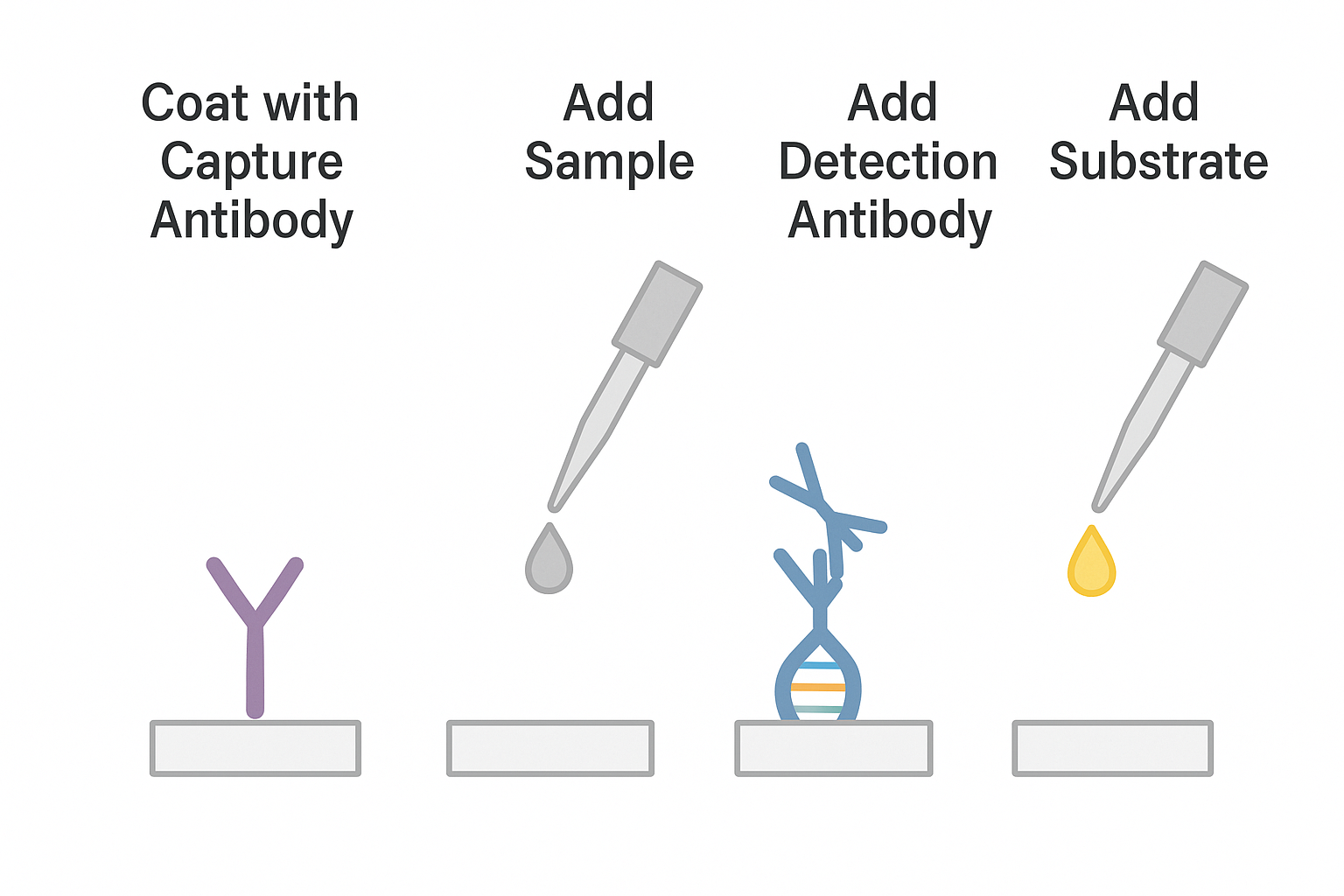
A dsRNA ELISA kit is usually based on a sandwich ELISA format using dsRNA-specific monoclonal antibodies (commonly J2 or related clones). Commercial kit descriptions give a consistent picture of the underlying design: MyBioSource+3creative-diagnostics.com+3yeasenbio.com+3
-
Capture phase
-
Microplate wells are pre-coated with purified anti-dsRNA monoclonal antibody.
-
dsRNA in standards and samples is immobilized when the sample is added to the coated wells.
-
-
Detection phase
-
A second anti-dsRNA antibody, frequently conjugated to horseradish peroxidase (HRP), binds to a separate epitope on the dsRNA.
-
This creates a dsRNA “sandwich”: capture antibody – dsRNA – detection antibody.
-
-
Signal development
-
HRP converts a chromogenic substrate (usually TMB) into a colored product.
-
Absorbance is read at 450 nm (with optional reference wavelength at 620–650 nm).
-
Concentrations are interpolated from a standard curve generated with a calibrated dsRNA standard.
-
The general features of ELISA (antigen immobilization, antibody–antigen binding, enzyme-linked detection) are reviewed in many teaching resources such as:
-
Enzyme-Linked Immunosorbent Assay – NCBI Bookshelf (NIH) NCBI
-
University of San Diego direct ELISA protocol home.sandiego.edu
-
University of Georgia (CCRC) ELISA protocol glygen.ccrc.uga.edu
A dsRNA ELISA kit essentially applies these standard ELISA concepts but uses antibodies selected for conformational recognition of dsRNA (independent of nucleotide sequence).

Typical workflow with a dsRNA ELISA assay kit
Below is a generalized workflow that matches common procedures described by kit manufacturers and academic ELISA manuals. CBDM Lab+4yeasenbio.com+4OZ Biosciences+4
Sample types
The double-stranded RNA ELISA kit is typically validated for:
-
Crude IVT reaction mixtures pre-purification
-
Purified IVT mRNA in formulation buffers
-
RNA extracted from cell cultures or viral stocks
-
Cell lysates containing replicating RNA viruses
-
Occasionally, purified viral dsRNA genomes or synthetic dsRNA standards (e.g., poly(I:C))
All samples should be free of interfering detergents or extreme salt concentrations and are usually diluted in the kit’s sample dilution buffer.
Plate layout
To maximize quantitative performance and Google indexing for “dsRNA standard curve” and “residual dsRNA quantification” keywords:
-
Reserve duplicate wells for blank, zero standard and serial dilutions of the dsRNA calibrator supplied with the kit.
-
Include matrix-matched controls (e.g., buffer-spiked dsRNA) for each sample matrix (IVT mix, formulated mRNA, viral supernatant, etc.).
Incubation steps (generic)
-
Sample addition
-
Add standards, controls, and diluted samples to wells pre-coated with capture antibody.
-
Incubate (commonly 1–2 h at 37 °C or RT with gentle shaking).
-
-
Washing
-
Wash 3–5 times with the kit’s wash buffer (PBS or Tris-based with 0.05–0.1% Tween-20). Protocols from Harvard, UAB, and other universities give effective wash strategies. CBDM Lab+2Vaccine UAB+2
-
-
Detection antibody
-
Add the HRP-conjugated anti-dsRNA detection antibody.
-
Incubate again (e.g., 1 h) to form the antibody–dsRNA–antibody sandwich.
-
-
Substrate addition and readout
-
Add TMB substrate, incubate for a fixed time (e.g., 10–20 min).
-
Stop the reaction with acid (e.g., 1 M H₂SO₄).
-
Read absorbance at 450 nm in a microplate reader.
-
Analytical characteristics of dsRNA ELISA kits
While exact performance specifications are kit-dependent, public technical data from several dsRNA ELISA products show typical ranges: MyBioSource+3acrobiosystems.com+3yeasenbio.com+3
-
Sensitivity
-
Limits of detection can reach single-digit pg/mL (e.g., ~9 pg/mL) for optimized high-sensitivity dsRNA ELISA kits.
-
-
Dynamic range
-
Often spans 2–3 orders of magnitude (e.g., 0.01–10 ng/mL or similar, depending on lot-specific calibrator).
-
-
Specificity
-
Capture and detection antibodies are designed to recognize A-form dsRNA helices and exhibit minimal cross-reactivity with single-stranded RNA or DNA, even in the presence of large molar excess of ssRNA.
-
-
Compatibility with modified nucleotides
-
Some kits are validated for modified RNAs, including pseudouridine, N1-methyl-pseudouridine, and 5-methoxy-uridine, where dsRNA impurities still arise and must be quantified. yeasenbio.com+1
-
These properties make the double-stranded RNA ELISA kit a robust tool for residual dsRNA impurity testing, especially in mRNA platform manufacturing where regulatory expectations are evolving. ScienceDirect+2Taylor & Francis Online+2
dsRNA ELISA in mRNA and RNA technology workflows
Several high-quality reviews and research articles highlight the role of dsRNA detection by ELISA in mRNA technology: Nature+3PubMed Central+3Organisation mondiale de la santé+3
-
mRNA vaccine and therapeutic manufacturing – ELISA is widely used as a release and in-process control test to ensure that dsRNA content remains within defined limits for each batch.
-
Platform development – elimination or reduction of dsRNA via process optimization, chromatography, or other strategies is tracked by dsRNA ELISA readouts.
-
Academic perspectives – the Martin Lab at UMass explains how low levels of dsRNA can sometimes act as an adjuvant, but higher levels can interfere with translation and dosage. See “RNA – Opportunities & Challenges” – UMass Amherst. martinlab.chem.umass.edu
-
University press releases such as UMass Chan’s report on mRNA drug manufacturing discuss how residual dsRNA is monitored and controlled using analytical tools like dsRNA ELISA kits. UMass Chan Medical School
In large-scale manufacturing proposals (e.g., University of Pennsylvania’s manufacturing strategy documents), the control of dsRNA is treated as a critical quality attribute alongside capping efficiency, poly(A) tail characteristics, and integrity. repository.upenn.edu
Connecting dsRNA ELISA to innate immune receptors
The length, structure, and cellular localization of dsRNA strongly influence how innate receptors respond:
-
TLR3 detects dsRNA in endosomes and is a well-characterized receptor for poly(I:C) and viral dsRNA. ScienceDirect+1
-
RIG-I preferentially binds short dsRNA with 5′-triphosphate ends.
-
MDA5 recognizes longer dsRNA and forms filaments along dsRNA helices. Columbia University+4Frontiers+4Cell+4
For a dsRNA ELISA kit, these receptor preferences are not measured directly; instead, the assay provides a total dsRNA mass readout. However, tuning IVT conditions and purification steps to reduce dsRNA levels measured by ELISA often correlates with reduced activation of TLR3/MDA5 pathways in cell-based experiments. OhioLINK+3PubMed Central+3ScienceDirect+3
Researchers can integrate dsRNA ELISA data with:
-
Reporter assays (e.g., IFN-β promoter luciferase) in TLR3/MDA5-expressing cell lines.
-
Transcriptomics of interferon-stimulated gene expression after exposure to RNA products with different dsRNA ELISA values.
This multi-layer approach supports detailed characterization of how dsRNA impurities influence innate immune readouts.
Practical tips for optimal dsRNA ELISA performance
To maximize both analytical quality and SEO signals around “reliable dsRNA ELISA results” and “troubleshooting dsRNA ELISA,” consider:
-
Sample preparation
-
Avoid strong chaotropes or high concentrations of EDTA in the final diluted sample.
-
If using RNase inhibitors, confirm compatibility with the specific dsRNA ELISA kit.
-
-
Standard curve quality
-
Prepare fresh serial dilutions of the dsRNA standard for each run.
-
Use log-transformed axes or 4-PL/5-PL non-linear fitting for best curve accuracy, as recommended in ELISA training materials from NCBI/NIH and university protocols. NCBI+2OHSU+2
-
-
Plate washing
-
Incomplete washing is a major source of high background and poor precision. Follow best practices such as those detailed by Harvard Medical School and UAB. CBDM Lab+1
-
-
Matrix effects
-
Validate dilution factors for each matrix (e.g., IVT buffer, formulation buffer) to minimize nonspecific interactions.
-
Spike-and-recovery and dilution linearity experiments are recommended.
-
-
Reproducibility and QC
-
Include internal QC samples (low, mid, high dsRNA controls) on every plate.
-
Track results over time with Levey-Jennings plots to detect shifts in assay performance.
-
Biosafety and regulatory context
Although dsRNA ELISA kits are typically labeled “For Research Use Only. Not for use in diagnostic procedures,” samples may still contain infectious agents or biologically active materials.
For safe handling:
-
Follow Biosafety in Microbiological and Biomedical Laboratories (BMBL) guidance from CDC/NIH and the CDC BMBL portal. NCBI+2CDC Stacks+2
-
Refer to biosafety level criteria summarized in the BMBL PDFs, accessible via CDC and academic re-hosts, e.g., CDC BMBL 6th edition PDF. CDC France+2dir.ca.gov+2
These documents outline containment requirements, PPE, and waste management for labs handling infectious or potentially infectious materials. They also help align internal procedures with evolving expectations for work involving viral vectors, RNA products, and adjuvant-like materials.
Choosing a double-stranded RNA ELISA assay kit – key technical criteria
When selecting a dsRNA ELISA kit for your lab, focus on technical, not brand-specific, parameters that index well in search engines:
-
Detection limit (LOD) in pg/mL
-
Quantitation range and linearity
-
Validation for modified nucleotides (pseudouridine, N1-methyl-pseudouridine, 5-methoxy-uridine)
-
Species and isotype of the anti-dsRNA antibodies (e.g., mouse IgG2a monoclonal)
-
Cross-reactivity data vs ssRNA, dsDNA, and other nucleic acids
-
Lot-to-lot consistency, supplied documentation, and example data for IVT mRNA
You can also verify that kit performance aligns with regulatory and scientific literature that treats dsRNA as a critical quality attribute for mRNA platforms (WHO regulatory document, EMA guideline, FDA technical briefing, peer-reviewed QC studies). biocompare.com+6Organisation mondiale de la santé+6European Medicines Agency (EMA)+6
Summary
A double-stranded RNA ELISA assay kit is a high-specificity, high-sensitivity immunoassay built on classic ELISA principles to quantify dsRNA across a broad dynamic range. It enables:
-
Accurate measurement of residual dsRNA impurities in IVT mRNA and related RNA products
-
Systematic comparison of process variations and purification strategies
-
Integration of biochemical QC with cell-based innate immune readouts, leveraging the well-characterized roles of TLR3, RIG-I, and MDA5 in dsRNA sensing
By linking your dsRNA ELISA kit product page to high-authority .edu and .gov resources such as NCBI, CDC, WHO, FDA, and university ELISA protocols, you provide users with credible scientific context and strengthen topical relevance for search engines. This technical but straightforward content positions the dsRNA ELISA kit as an essential tool for modern RNA biology, viral vector research, and mRNA platform development, while staying clearly within research-use-only scope.