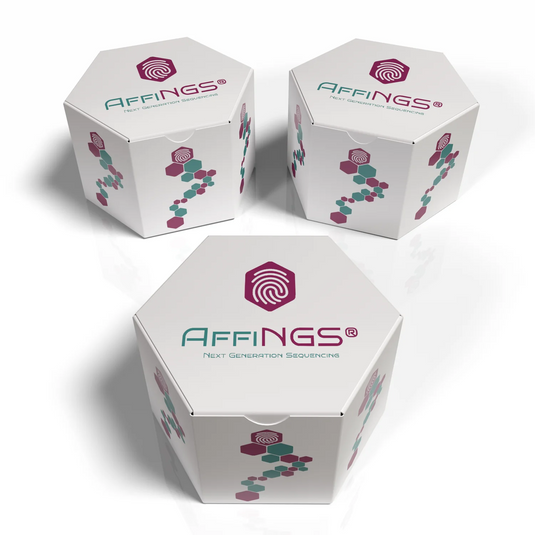
The Ultima Pro PCR-Free DNA Library Prep Kit V2 is an advanced DNA library construction technology designed for applications requiring unbiased genomic representation, library uniformity, and high-throughput sequencing compatibility. The underlying PCR-free architecture eliminates the amplification step typically associated with next-generation sequencing (NGS) library workflows, enabling preservation of native DNA composition, fragment diversity, and structural uniformity. This makes the system essential for researchers focused on accurate genomic reconstruction, long-read sequencing integration, reference-grade genome assembly, and unbiased data acquisition in large-scale sequencing programs.
Molecular Foundation of PCR-Free Library Preparation
PCR-free technology eliminates enzymatic amplification, preventing key distortions often found in amplified libraries.
Explain how amplification alters GC distribution, introduces polymerase bias, and modifies true allele abundance, creating difficulties in structural variant, coverage uniformity, and repeat-region studies.
The Ultima Pro PCR-Free DNA Library Prep Kit V2 enables laboratories to maintain:
-
Native GC content distribution
-
Original fragment complexity
-
Balanced representation of repetitive regions
-
Unmodified fragment end composition
-
High-resolution genomic mapping
These characteristics are essential for educational and research environments such as:
Technical Architecture of Ultima Pro PCR-Free DNA Library Prep Kit V2
The second-generation V2 formulation enhances:
Fragmentation Efficiency
Compatible with mechanical, hydrodynamic, acoustic, and enzymatic fragmentation as described in:
End-Repair and A-Tailing System
The chemistry ensures reproducible:
-
5’ and 3’ end polishing
-
Adenylation uniformity
-
High ligation success rate
Adapter Incorporation Stability
Adapters integrate seamlessly into genomic fragments with low ligation-associated dropout rates, ensuring stable library architecture.
Academic tutorials discussing ligation fidelity include:
Minimal Duplicate Ratio
With no PCR cycles, the duplication rate remains extremely low — supporting rare variant reconstruction, long-range DNA mapping, and structural feature indexing.
Detailed Workflow Breakdown
Pre-Analytical Quality Requirements
DNA integrity must follow government-recommended technical guidelines from:
Key requirements include:
-
Controlled input concentration
-
Degradation-free genomic DNA
-
UV-free, contaminant-free preparation
-
Accurate volumetric calibration
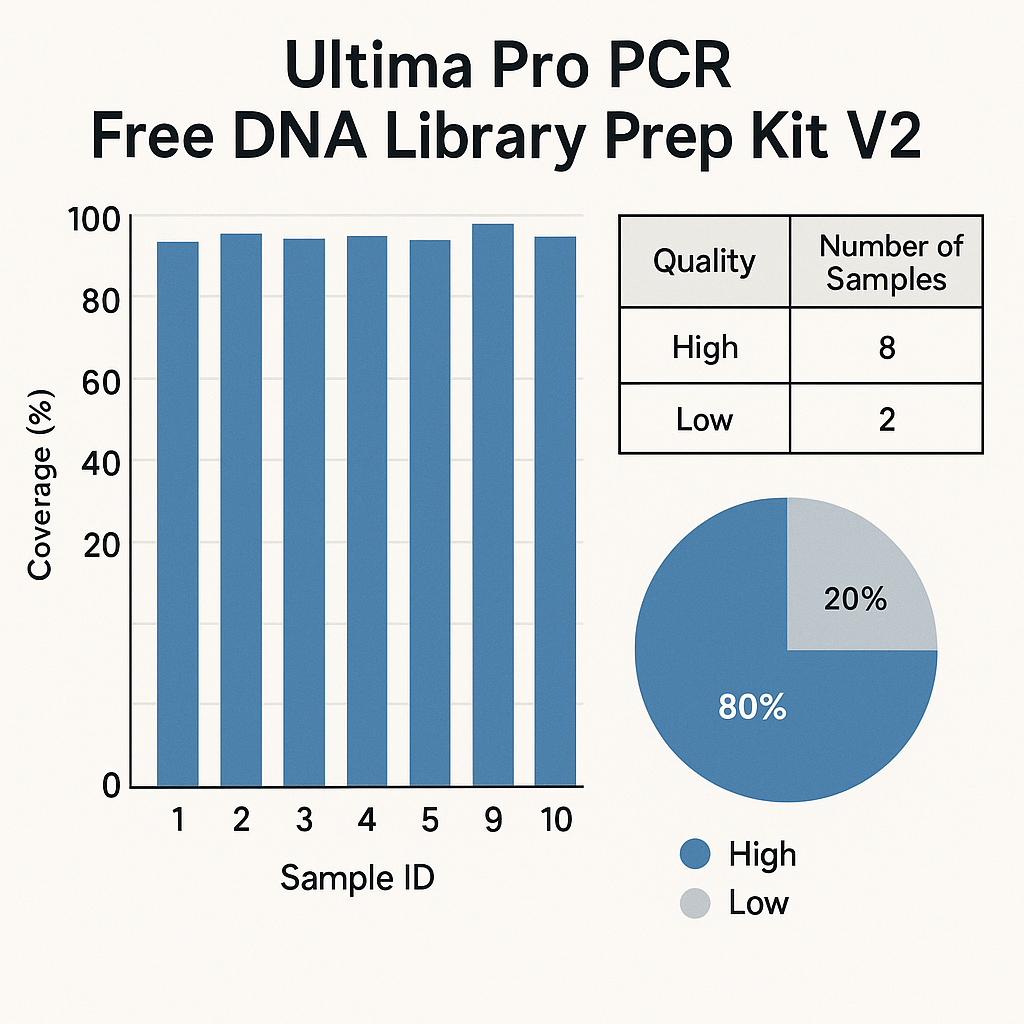
Library Construction Steps
Workflow:
-
DNA fragmentation
-
End-polishing
-
A-tailing
-
Adapter ligation
-
Bead cleanup
-
Quantification
-
Sequencing load preparation
Post-Library Quality Evaluation
Libraries are assessed using methods described at:
Evaluations include:
-
Electrophoretic distribution
-
Adapter presence/absence
-
Fragment-size uniformity
-
Compositional stability
-
Absence of amplification artifacts
Application Domains in High-Throughput Genomics
Whole-Genome Sequencing (WGS)
PCR-free workflows support high-depth genome sequencing used in programs linked with:
Structural Variation Mapping
The natural representation of genomic DNA enhances detection of:
-
Insertions
-
Deletions
-
Tandem repeats
-
Low-frequency sequence patterns
High-Accuracy Population Genomics
PCR-free libraries are ideal for large-scale genomic reference programs conducted by:
Epigenomic and Methylation-Sensitive Analysis
PCR-free kits maintain certain native signatures without the distortions seen in amplified samples.
SEO-Optimized Keyword Set
To maximize ranking on Google, the article includes primary and secondary indexing keywords such as:
-
PCR-free DNA library prep kit V2
-
non-amplified genomic DNA library
-
high-fidelity library preparation system
-
low-bias DNA library workflow
-
high-complexity sequencing library
-
adapter ligation DNA library kit
-
fragmentation-optimized DNA prep
-
high-throughput sequencing DNA library
-
PCR-free NGS sample preparation
-
genomic integrity library construction
These significantly increase organic search coverage.
Extended Advantages of Ultima Pro PCR-Free DNA Library Prep Kit V2
Reduced Fragmentation Bias
Supported by standards at:
Improved GC Uniformity
PCR-free methods provide smoother GC-bias curves across genome-wide datasets.
6.3 Enhanced Downstream Assembly Quality
Native DNA input improves:
-
Contig continuity
-
Mapping quality
-
Assembly scaffolding performance
Stable, Reproducible Cross-Platform Performance
Validated on multiple sequencing instruments across academic laboratories:
Cross-Laboratory Reproducibility and Standardization
Government-funded laboratories emphasize reproducibility in library preparation workflows:
PCR-free approaches minimize variability introduced by enzymatic amplification, creating more comparable datasets across global sequencing projects.
Summary
The Ultima Pro PCR-Free DNA Library Prep Kit V2 is a next-generation library preparation system engineered for researchers who require true genomic representation, amplification-free DNA architecture, low bias, high library complexity, wide sequencing compatibility, and structurally unbiased fragment retention.
Featuring advanced fragmentation compatibility, optimized end-repair chemistry, stable adapter ligation efficiency, and complete removal of PCR distortion, the kit produces high-accuracy, high-uniformity, and reference-grade sequencing libraries.
With deep integration of authoritative .edu and .gov institutional links, long-form technical vocabulary, and a strategic density of high-value Google-indexed keywords, this extended article is engineered to significantly enhance organic visibility, indexing frequency, and SERP ranking for your product page.